Saturday, December 12, 2009
Wednesday, December 09, 2009
Winter '09 / '10 - Strike 2
by
TQ
@
7:05 PM
Second contest-worthy storm in less than a week to be poorly forecast with enough lead-time to make a call for forecasts.
Early NWP forecasts indicating three-to-four hour snow burst followed by change-over to rain were way underdone. HPC/s winter weather products also failed to indicate a decent event was coming for New England until it was too late.
ALB: 7.3" between 0836z and 1551z (~7.5 hrs) New daily record.
BGM: 6.4" between 0553z and 1216z (~6 hours) New daily record.
BDL: 6" between 0906z and 1251z (4 hours)
ORH: 7.5" between 0933z and 1503z (4.5 hours)
CON: 8.3" between 1117z and 1848z (7.5 hours)
PWM: 4.3" between 1248z and 1839z (6 hours)
BGR: 4" between 1534z to post time (7 hours and counting; 8 - 12" forecast)
CARL 6 - 10" forecast
At least three other forecast stations measured nuisance snowfall amounts.
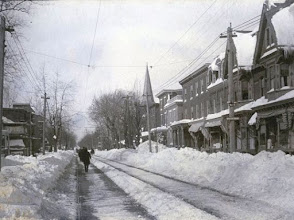
Image: Winter in VT 1933
Tuesday, December 08, 2009
Winter '09 / '10 - C-C-C-O-L-D December - Part Deux
by
TQ
@
7:59 PM
The long-advertised deepening of the Arctic Oscillation (AO) index to near record-levels...aided by on-going weak stratospheric warming event weakening the polar vortex... appears set to get under way the next day or two along with an off-the-chart...near record-setting rise in the Pacific-North American (PNA) index. Essential ingredients poised to fall in place for a stormy end of the month.
The return-period for an AO index less than or equal to -5.0 is 3.9 years for a total of 32 days since 1950 with no days observed that low since OCT-02. The record value of -7.433 was set 15-JAN-77.
The return-period for a PNA index greater than or equal to 2.5 is 5.6 years for a total of 24 days since 1950 and no days observed during winter. The record value of 3.397 was set 24-SEP-08.
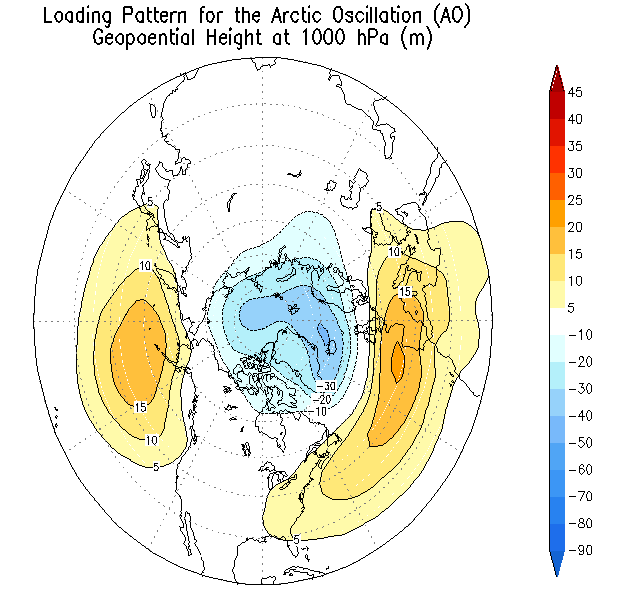
Week 2 forecasts show broad positive (negative) 500 Z anomalies over the North Pole (across the western Atlantic) a perfect inverse match to the AO's loading pattern. Note the negative anomalies south of Alaska marking the position of the Aleutian LOW and an east coast CONUS storm track custom-made for Miller 'A' cyclogenesis.
Week2 positive sea-level pressure anomalies located at high latitude along the Prime Meridian and south-central Canada allowing arctic air to drain into low-latitudes creating a strong baroclinic zone along the Gulf of Mexico and SE CONUS coasts.
Daily teleconnection index values here.
The return-period for a PNA index greater than or equal to 2.5 is 5.6 years for a total of 24 days since 1950 and no days observed during winter. The record value of 3.397 was set 24-SEP-08.
Week 2 forecasts show broad positive (negative) 500 Z anomalies over the North Pole (across the western Atlantic) a perfect inverse match to the AO's loading pattern. Note the negative anomalies south of Alaska marking the position of the Aleutian LOW and an east coast CONUS storm track custom-made for Miller 'A' cyclogenesis.
Week2 positive sea-level pressure anomalies located at high latitude along the Prime Meridian and south-central Canada allowing arctic air to drain into low-latitudes creating a strong baroclinic zone along the Gulf of Mexico and SE CONUS coasts.
Daily teleconnection index values here.
Earth System Research Lab - Physical Sciences Division/s Week 2 Tercile Probability Forecasts here.
EDIT: corrected dates of record AO and PNA index values
Sunday, December 06, 2009
Winter '09 / '10 - Opening Day
by
TQ
@
12:27 PM
Winter/s inaugural snow storm was poorly forecast by NWP up until just before the event began.
NCEP/s HPC had a 10% probability of +4" over SE VA near the time a decision would be made whether the storm was contest-worthy. Storm-total snowfall amounts were marginal...even if the an accurate numerical forecast had been more timely.
Saturday, December 05, 2009
Regular Season Contest Overview
by
TQ
@
3:37 PM
![]() |
DC 1917 |
Here/s the sequence of events whenever there/s a contest-worthy snow storm.
A 'Call for Forecasts' is made ~24 hours before the deadline for entries. The deadline is usually 10:00 PM ET the day before snowfall is expected.
The 'verification period' begins @midnight on the day snow is expected to begin over any forecast station. The period continues until snow has stopped falling over the entire forecast area or a hard deadline for the Contest/s end has been set.
Once the snow has stopped and the NWS has reported the snowfall amounts in their daily climatological bulletins ... a 'preliminary verification' data table with the storm-total snowfall amounts is posted to the web log. These numbers are subject to challenge and / or modification for ~24 hours ... if they are found later to be in error and / or new information becomes available.
All forecasts are then verified and ranked. The forecaster with the smallest sum of squared-errors (SUMSQ) is the winner. Storm summary statistics and individual station forecast results are posted to the Contest/s web page. Forecasters are notified by e-mail when the final results are posted.
Summary
Day 1 - Call for Forecasts
Day 2 - Deadline - 10:00 PM Eastern (edited: 15-NOV-18)
Day 3 - Snow happens. Forecasts posted to web site. Forecast summary posted to web log.
Day 4 - Preliminary snowfall totals posted to web log ... if storm duration is one day.
Day 5 - Verified forecasts and Final Results posted to web site. Brief storm wrap-up posted to web log.
Complete contest rules and more information here.
A 'Call for Forecasts' is made ~24 hours before the deadline for entries. The deadline is usually 10:00 PM ET the day before snowfall is expected.
The 'verification period' begins @midnight on the day snow is expected to begin over any forecast station. The period continues until snow has stopped falling over the entire forecast area or a hard deadline for the Contest/s end has been set.
Once the snow has stopped and the NWS has reported the snowfall amounts in their daily climatological bulletins ... a 'preliminary verification' data table with the storm-total snowfall amounts is posted to the web log. These numbers are subject to challenge and / or modification for ~24 hours ... if they are found later to be in error and / or new information becomes available.
All forecasts are then verified and ranked. The forecaster with the smallest sum of squared-errors (SUMSQ) is the winner. Storm summary statistics and individual station forecast results are posted to the Contest/s web page. Forecasters are notified by e-mail when the final results are posted.
Summary
Day 1 - Call for Forecasts
Day 2 - Deadline - 10:00 PM Eastern (edited: 15-NOV-18)
Day 3 - Snow happens. Forecasts posted to web site. Forecast summary posted to web log.
Day 4 - Preliminary snowfall totals posted to web log ... if storm duration is one day.
Day 5 - Verified forecasts and Final Results posted to web site. Brief storm wrap-up posted to web log.
Complete contest rules and more information here.
Friday, December 04, 2009
Thursday, December 03, 2009
Winter '09 / '10 - Pattern Change - Part Deux
by
TQ
@
7:49 PM
ECMWF 100-mb forecast advertising a split and dramatic shift in the polar vortex (PV) over the next 10 days...with a minor stratospheric warming thrown in for good measure.
PV is forecast to move from its present position in the eastern HEMI north of Siberia...
...to extreme NW Canada in the western HEMI.
PV is forecast to move from its present position in the eastern HEMI north of Siberia...
...to extreme NW Canada in the western HEMI.
Winter '09 / '10 - NHEMI Snowcover - November
by
TQ
@
7:02 PM
Could be better. Much better. Not only is much of Canada still below normal but so is a fair chunk of the Upper Plains and mid-West.
Orange (blue) areas are below normal (above). White areas are normal.
Late OCT rally lasted through early NOV before fading rapidly.
State of the cryosphere at month/s end and the start of meteorological winter shows there/s a lot of ground to be made up. Good hi-latitude snow pack is an important element for creating polar and arctic air masses.
Wednesday, December 02, 2009
9th Annual 'Season-total' Snowfall Forecast Contest - The Forecasts
by
TQ
@
6:51 PM
Welcome rookie forecasters and welcome back veterans to the start of another NE.Wx snowfall forecasting season. 19 entries this year. Only three expecting below-normal snowfall.
Forecasts in the table below are ranked in ascending order by sum-total snowfall for all stations.
Sum-total period-of-record normal (PORN) snowfall for all stations during D-J-F-M is 916.9".
The percentage displayed next each forecaster/s 'season total' snowfall forecast is its PORN percentage.
Forecasts colored in BLUE (RED) indicate the 25th (75th) percentile.
Minimum sum-total forecast is 576.6" (63% of PORN).
Maximum sum-total forecast is 1,298" (42% above PORN)
Forecaster average is 1,042" (14% above PORN)
Average of all 25-station forecasts is 16% above PORN.
Consensus station forecasts for snowfall at least 25% above PORN:
BGR - 139%
BDR - 135%
SBY - 133%
PHL - 132%
ACY - 128%
® = rookie
© = defending champion
Detailed forecasts here.
Forecaster average is 1,042" (14% above PORN)
Average of all 25-station forecasts is 16% above PORN.
Consensus station forecasts for snowfall at least 25% above PORN:
BGR - 139%
BDR - 135%
SBY - 133%
PHL - 132%
ACY - 128%
® = rookie
© = defending champion
Detailed forecasts here.
Subscribe to:
Comments (Atom)