Wednesday, October 14, 2009

Winter '09 / '10 - AccuWeather - Update 2


Joe Bastardi...Chief Meteorologist:
"...winter will be centered over an area from Maryland to the Carolinas as a fading El Niño results in the stormiest and coldest pattern in recent years.

"The areas that will be hit hardest this winter by cold, snowy weather will be from southern New England through the Appalachians and mid-Atlantic, including the Carolinas. Areas from Washington D.C. to Charlotte have had very little snowfall the past two winters. This season these areas could end up with above-normal snowfall.

"Northern areas, including Buffalo, Boston and Maine, have been hit hard the past couple of winters, but will see normal snowfall with temperatures slightly below normal this winter.

"Cities such as New York, Boston and Philadelphia could get up to 75 percent of their total snowfall in two or three big storms."
This is a classic +ENSO / -Arctic Oscillation (AO) forecast with main precipitation track across the southern tier and Miller 'A' (.pdf) nor'easters up the east coast...although it does not appear to be a good fit with the accompanying temperature outlook...which matches closely to either a positive or neutral AO state.

More...

Tuesday, October 13, 2009

Early Snows in Austria

(updated below)

"Austria’s provincial capitals are expected to see their earliest snowfalls in history today (Mon) as Arctic air sweeps the country."
[...]
"The (previous) record for early snow in provincial capitals was set in 2007, when snow remained on the ground in some of them from 20 to 24 October."

More...

UPDATE:
"Austria sees biggest October snowfall in 25 years"

"Austria was hit by a record October snowfall late on Tuesday when strong winds and heavy snow caused power blackouts, train delays and traffic accidents.

"...also predicted...30 and 40 centimeters (12 - 16") of snow would be likely to fall this week."
More...

Snow Season Begins in Japan


From 'Snow Season Japan' blog...

"The first snowfall for the 2009/2010 winter season has arrived on the Hakuba peaks. Hakuba usually sees it’s first snowfall around the middle of October each season, so it’s bang on time. Everything is looking very promising
[...]
"In Japanese, we call the first snow is called Hatsuyuki, Hatsu meaning ‘first’ and Yuki meaning ’snow’"
More...

Winter '09 / '10 - NHEMI Snowcover mid-October

Anomaly / Observed


L-a-r-g-e swath of anomalous snowcover over the northern and central plains...the upper Midwest...and much of Canada.

Miles wide and an inch deep in many places but it/s a good start. Many stations saw their earliest snows on record and others weren/t far behind. Similar reports of early snows elsewhere...as well.

Images courtesy Rutgers Global Snow Lab

Wednesday, October 07, 2009

Winter '09 / '10 - Quick Hit Outlooks

US Department of Energy:
"...slightly milder weather than last winter..."
National Weather Service:
"...equal chances of a mild winter, normal winter or cold winter..."
Weather2000 (chief meteorologist Michael Schlacter):
"...probably average colder than normal and that we can look forward to dramatic swings in temperatures. It's going to be a cyclonic, volatile, wacky winter..."
AccuWeather (senior meteorologist Henry Margusity):
"...expect colder temperatures than last winter and more snow - almost twice as much as last winter's 28 inches in New York City. We're looking at this part of the country being on the cold side..."
More...

Monday, October 05, 2009

Winter '09 / '10 - Early October Snowcover

Judah Cohen...director of seasonal forecasting:

"Scant early snowfall in Siberia indicates Arctic wind patterns may reduce cold air flows into the Northeast U.S. this winter, contradicting forecasts that a weak El Niño will cause the coldest season in a decade, a climate scientist said.

“Our forecast for this winter is pretty warm,” Judah Cohen, director of seasonal forecasting at Atmospheric and Environmental Research Inc. in Lexington, Massachusetts, said yesterday at a conference in New York. “Siberian snow cover has been running well below normal."

"Cohen said a rapid buildup of snow in Siberia this month could alter his forecast that so-called Arctic oscillation patterns will create a warm Northeast.

"“In a week’s time, Siberia can get enough snow to cover the entire U.S.,” he said."
More...

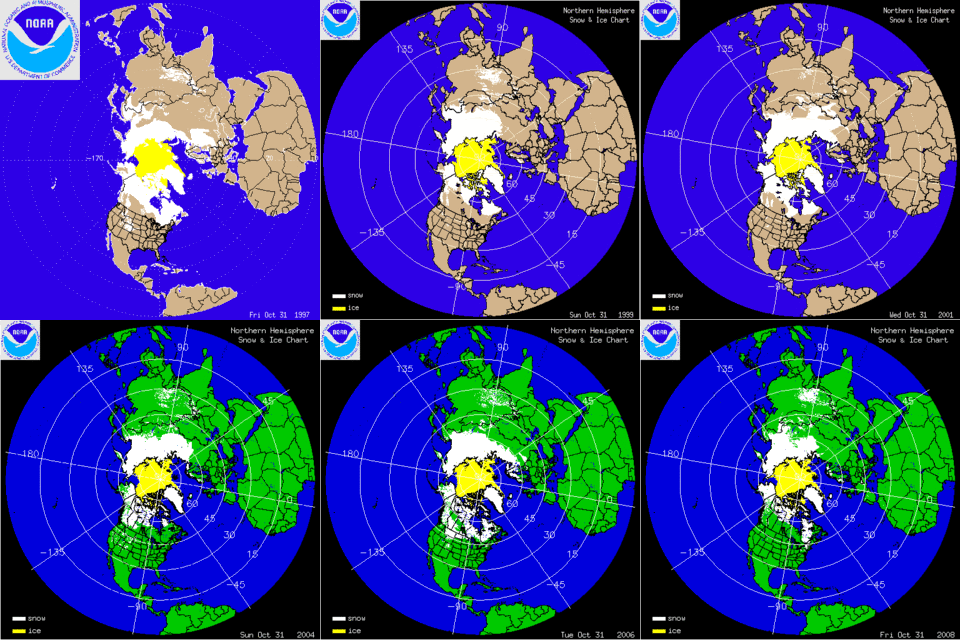
Historical NHEMI Snow Cover 10/2

October 2 1997 - 2009


End of October 1997 - 2009

Appears 2008 Eurasian snowcover was fairly low compared to the other images....and last winter was notable for a good portion of the forecast area.

Associations Between ENSO and AO in Winter

A moderately warm ENSO event seems to be a lock this winter. The multi-variate ENSO Index (MEI) is bullish as are a majority of numerical and statistical ENSO forecast models...even though the Southern Oscillation (data) hasn/t made up its mind.

Conventional wisdom suggests this scenario favors a split-flow regime with an active...moisture-laden sub-tropical jet (STJ) and opportune phasing with the polar jet (PJ) and producing strong cyclogenesis along the eastern seaboard. Add arctic HIGH pressure over eastern Canada and it/s snow-time.

The graphic below was extracted from NCEP/Climate Prediction Center/s ATLAS No. 8 - Relationships Between El Niño-Southern Oscillation and the Arctic Oscillation: A Climate-Weather Link

It shows composite fields for 500 mb geo-potential height...surface temperarture...and precipitation during +ENSO and three phases (positive...neutral...and negative) of the Arctic Oscillation (AO).

Best-case for snow crows during warm ENSO is a negative AO (bottom row of charts).

Otherwise...the mid-level long-wave trof axis is suppressed to the south...(neutral AO) or there/s no trof at all (+AO) and temperatures are above normal with the best moisture contained across the Deep South and the Mississippi and Tennessee River valleys.

Sunday, October 04, 2009

Winter '09 / '10 - WSI

Todd Crawford - Seasonal Forecaster:

"A moderate El Nino event will likely persist through the winter, resulting in cool weather across the Southeast”[...]. “However, ocean temperatures in the North Pacific are not currently supportive of a typical El Nino pattern this upcoming winter. If this persists, this winter will likely be colder in the western US than is typical during El Nino events.

"In the Northeast, we expect a relatively mild fall, with increased chances of sharply colder weather after the New Year. The combination of various climate indices suggests that the winter will likely arrive late but loudly in much of the East, and that a mild start will not necessarily persist through the winter.

"In December, WSI forecasts:
Northeast – Warmer than normal"
More...

Saturday, October 03, 2009

North Atlantic Oscillation - September '09

+1.51

2007...2000...1956...1974...and 1999 are still the best NAO-analog years after the addition of September/s data point. Only change was '74 and '99 switching places from August/s rankings.

What/s it all mean...Mr. Peabody?

2007: -ENSO...+AO...-PDO...-QBO...sun spots below normal
2000: -ENSO...-AO...+PDO...-QBO...sun spots near normal
1956: -ENSO...+AO...-PDO...-QBO...sun spots above normal
1974: -ENSO...+AO...-PDO...-QBO...sun spots below normal
1999: -ENSO...+AO...-PDO...+QBO...sun spots near normal

El Niño more than likely this winter...so how much utility is there using NAO analog years given their unanamous association with -ENSO?

Saturday, September 26, 2009

Winter '09 / '10 - Quasi-biennial Oscillation

The Quasi-biennial Oscillation (QBO) is characterized by alternating easterly and westerly descending wind regimes at the equator. It dominates the variability of the tropical stratosphere. Although the QBO is a tropical phenomenon...it affects the stratospheric flow from pole to pole by modulating the effects of extra-tropical waves. [M. P. Baldwin et.al., 2001 (.pdf)]

The period of oscillation varies between 20 and 36 months...with an average period of about 28 months...as measured over the past half-century. The QBO index at each stratospheric level is the zonally-averaged zonal (east-west) wind. It is the most predictable inter-annual climate fluctuation on the planet.


August QBO @30mb is -14.46 (data)...three months into its nascent easterly phase. It/s expected to remain easterly through spring 2010...reaching its peak amplitude (< -25) during the heart of meteorological winter.

QBO is important b/c it determines the character of the early winter. The east phase leads to a more disturbed and warmer Arctic in December and January. During winter...QBO appears to excite the 'northern annular mode' (aka Arctic Oscillation [Thompson and Wallace, 1998 (.pdf), 2000]. Its easterly phase is represented in composites geo-potential...wind...and temperature fields by a weaker polar vortex (PV)...warmer polar temperatures...and higher geo-potential heights at hi-latitudes. In years with low solar activity...the winter PV tends to be disturbed and weak when the QBO is easterly.

Monthly sunspot activity YTD (data) has been anomalously quiet (lowest 10th percentile) 24 of the past 32 months and every month since April 2008. Top-5 sunspot analog years: 1913...1823...1811...1810...1912.

Reconstructed NAO index (Li) for '12/'13 is 1.44 and '13/'14 is 1.63... neither of which lend any support to a correlation between weak PVs with its implied -AO/-NAO and extremely low sunspot activity.

Top-5 sunspot analogs for years beginning 1950 and their D-J-F AO/NAO: 2008 (0.259/-0.08)...1954 (-0.717/-0.76)...1996 (-0.096/-0.07)...1964 (-1.125/-0.61)...1976 (-2.617/-1.04) supports the correlation.

Polar temperature varies out of phase with sunspot activity (low sunspot activity ==> warmer temperature ==> higher geo-potential heights) for winters when the QBO is easterly. Weak...'warm' PVs are less able to contain arctic air masses at hi-latitudes than cold...strong...less disturbed PVs. This suggests potentially favorable conditions this winter for arctic outbreaks leading to strong baroclinic zones developing between land and water which represent prime conditions for cyclogenesis and block-buster Nor'easters.

Easterly QBO also favors the occurrence of major winter stratospheric warmings [Holton and Tan (1980)(.pdf)]. Stratosphere warmings propagate from 10mb to the surface in ~3 weeks. Should such a warming occur mid-winter during QBO minimum...it could very well signal a cold end to meteorological winter.
-----
Should QBO play a dominant role this winter...

  • Easterly phase during low solar activity ==> favors weak PV
  • Weak PV ==> high heights @ hi-latitudes
  • High heights @ hi-latitudes ==> negative northern annular modes (-AO / -NAO)
  • -AO / -NAO ==> arctic outbreaks + increased east coast snowfalls
  • Easterly phase favors major stratospheric warmings ==> lagged arctic outbreaks

QBO analogs YTD.

1991 is currently the leading analog. Winter '91 / '92 featured +ENSO (albeit one that became strong by spring)...+AO...+NAO...and -SOI...all of which go against type for -QBO. Did anonymously high (96th percentile) monthly sunspots play an active and deciding role?

EDIT: corrected sign of Winter '91 SOI.